Hearing the words “Your child has Autism Spectrum Disorder (ASD)” from a developmental pediatrician can make time feel like it is standing still.
Whether you felt a sudden wave of relief after months of wondering, or a heavy weight in your chest as you walked out of the clinic, take a deep breath. Whatever you are feeling right now—overwhelmed, confused, anxious, or even numb—is completely valid.
First, know this: Your child is still the exact same loving, unique, and wonderful child they were before you opened that evaluation report. A diagnosis is not a boundary that limits who they can become; it is simply a roadmap that helps us understand how their mind works and how to support them best.
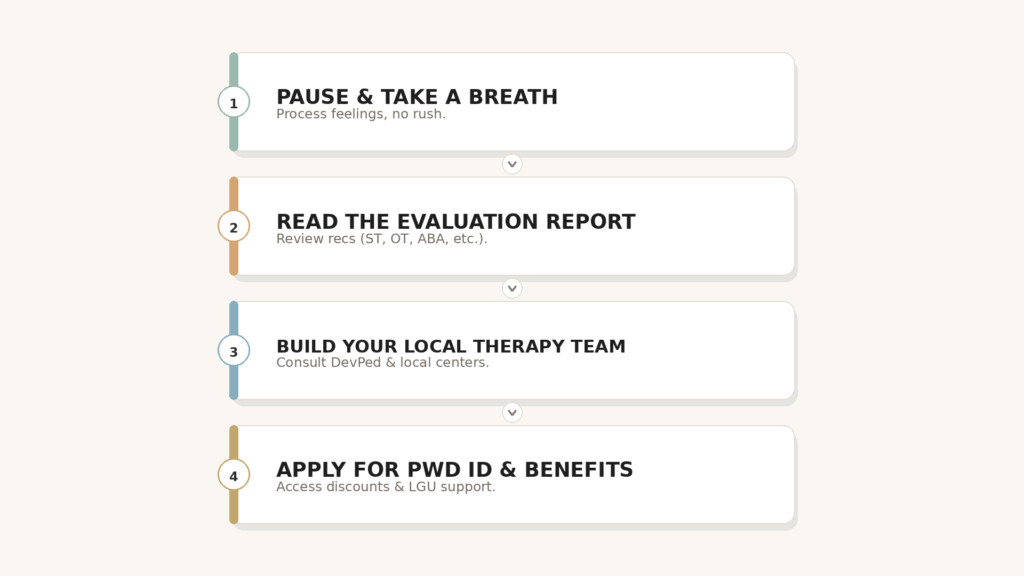
If you are wondering what to do next in the Philippines, here is a practical, step-by-step roadmap to help you navigate these first few weeks with confidence and clarity.
Step 1: Pause and Give Yourself Space to Process
Before rushing to book every therapy center in Metro Manila or provincial capitals, give yourself permission to pause.
In Filipino culture, family is everything, and it’s natural to want to fix things immediately or worry about what relatives might say. Take a moment with your partner or immediate family to process your emotions together.
Remember: Autism is not caused by bad parenting, screen time, or anything you did “wrong” during pregnancy or early childhood. It is simply a neurodevelopmental difference.
Step 2: Read Your Developmental Pediatrician’s Written Report
Your Developmental Pediatrician (DevPed) or Child Psychologist will provide a formal clinical report. When you get home, set aside a quiet hour to review the Recommendations section carefully.
Typically, the recommendations will suggest specific developmental therapies based on your child’s needs:
| Recommended Therapy | What It Focuses On | Common Goals for Children |
| Speech-Language Therapy (ST) | Communication, expression, and understanding. | Building words, using AAC (speech devices/picture cards), or improving conversational flow. |
| Occupational Therapy (OT) | Sensory processing, fine motor skills, and daily living. | Calming sensory overloads, holding a pencil, eating independently, or dressing up. |
| Applied Behavior Analysis (ABA) / Behavioral Therapy | Behavior modification, skill building, and learning routines. | Reducing unsafe behaviors, teaching self-regulation, and strengthening task focus. |
| Physical Therapy (PT) | Gross motor development and body awareness. | Improving balance, coordination, jumping, and core strength. |
| Special Education (SPED) / Early Intervention | Academic readiness, structured learning, and social play. | Preparing for school settings, peer engagement, and structured tasks. |
Step 3: Organize Your Child’s Medical & Therapy Folder
You will be interacting with various professionals, centers, and government offices over the coming months. Staying organized from Day 1 saves immense time and stress.
Create a physical binder or dedicated digital folder containing:
- The formal Developmental Evaluation Report.
- Medical prescriptions or clearance letters from your pediatrician.
- Hearing test or vision test results (if requested by your doctor).
- Progress reports from therapy sessions (as you begin).
- Copies of your child’s Birth Certificate (PSA) and Barangay Certificate.
Step 4: Apply for a Persons with Disability (PWD) ID
In the Philippines, an autism diagnosis qualifies your child for a PWD ID card under national law (RA 10754 and RA 9442). This provides crucial financial and logistical support for families.
Benefits of a PWD ID in the Philippines:
- 20% Discount + 12% VAT Exemption on medical and dental services, professional fees of attending doctors, and accredited therapy sessions.
- 20% Discount + 12% VAT Exemption on medicines and medical supplies.
- Discounts on basic groceries and prime commodities (via LGU/DTI guidelines).
- Express lanes in establishments, therapy centers, and government facilities.
How to Apply:
- Visit your local City/Municipal Social Welfare and Development Office (CSWDO) or Persons with Disability Affairs Office (PDAO) at your City Hall.
- Bring the required documents:
- Copy of the DevPed Clinical Report / Medical Certificate specifying the diagnosis.
- PSA Birth Certificate of the child.
- 1×1 or 2×2 ID photos of your child (check your LGU’s specific requirement).
- Barangay Clearance or proof of residency.
- Valid ID of the parent or legal guardian.
Step 5: Begin Looking for Local Therapy Centers
Finding the right therapy center and therapists is one of the most significant steps you’ll take. Because therapy waitlists in major Philippine urban areas (like Metro Manila, Cebu, and Davao) can sometimes take weeks or months, it is wise to start inquiring early.
1.Inquire and Check Availability: Step 5A.
Contact therapy centers near your area to ask about evaluation slots, therapist availability, and current waitlists for ST, OT, or ABA.
2.Schedule an Initial Intake / Assessment: Step 5B.
Most centers require an internal assessment by their lead therapist before placing your child into an active schedule. Bring your DevPed report to this session.
3.Observe the Environment and Fit: Step 5C.
Look for a center where therapists are patient, compassionate, and welcoming. Your child should feel safe and respected during their sessions.
Step 6: Focus on Simple Home Strategies Today
You do not need to wait for therapy sessions to start supporting your child’s development at home. Simple daily adjustments can make a world of difference:
- Use Visual Supports: Many neurodivergent children are strong visual learners. Simple picture schedules or pointing to physical objects helps reduce anxiety about what comes next.
- Simplify Instructions: Use clear, short sentences (e.g., “Put on shoes” instead of “Can you please go over there and put your shoes on right now?”).
- Follow Their Interests: Connect with your child through what they already love—whether that’s lining up toy cars, watching spinning wheels, or listening to nursery rhymes. Join their play before asking them to join yours.
- Create a Calm Corner: Set up a quiet space at home with soft pillows or favorite toys where your child can retreat when sensory input becomes overwhelming.
You Are Not Alone on This Journey
Navigating a new diagnosis takes time, patience, and community. Connecting with other parents who are on the exact same path can make the journey feel much lighter.
If you ever feel lost or simply need a safe space to ask questions, celebrate small wins, or read advice from other Filipino parents, consider joining the Ausome Therapy Community. It is a supportive community of parents, guardians, and advocates sharing authentic experiences and helpful guidance every day.
Find Pediatric Therapy Near You
Looking for specialized support? Browse our directory of verified developmental centers near you: